Home Office Decluttering: A Zone-by-Zone Plan
Clear an office that has turned into a storage room by working through eight zones in a fixed order, with six sorting choices, a staging box and a clean way to stop.
A home office becomes a storage room one object at a time. A delivery box that was going back, an old printer, bags of paper to sort later, the vacuum cleaner. Eventually the desk is the only clear surface, and then not even that.
Home office decluttering goes faster when you stop looking at the whole room. This plan divides it into eight zones, taken in a fixed order, with the same six sorting choices in each. Every zone leaves the room more usable than before, so you can stop after any of them.
Set up before you start
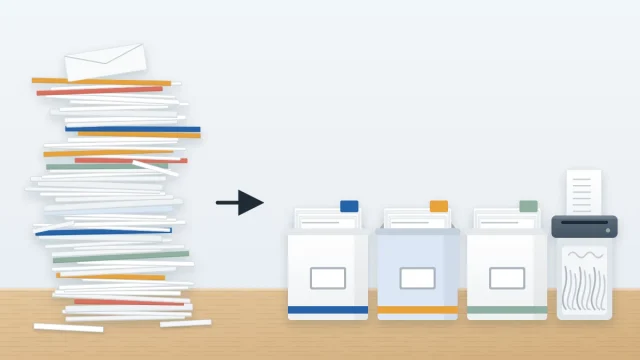
Gather six containers and mark each one clearly. Boxes, bags or laundry baskets all work.
| Container | What goes in | Where it ends up |
|---|---|---|
| Keep elsewhere (staging box) | Things that belong in another room | Delivered room by room at the end of the session |
| Donate | Usable items you no longer need | By the front door or in the car |
| Recycle | Paper, empty boxes and packaging with no personal details | Household recycling |
| Shred | Any paper showing personal details | Shredded, then recycled |
| Trash | Broken or used-up items that cannot be recycled | Household trash |
| Electronics | Old devices, cables and batteries | A local recycling program |
The sixth choice needs no container: keep here. Those items go back into the zone once it is empty and wiped.
The staging box matters most. It stops you from leaving the room every few minutes to put a single item away.
The order of zones
Work through the room in this order. Each zone frees up the space you need for the next one.
- Floor
- Desk surface
- Drawers
- Shelves
- Paper
- Supplies
- Cords
- Old equipment
In each zone the method is the same: empty it, sort every item into one of the six choices, wipe the empty space, and return only the keep-here items.
Zones 1 and 2: floor and desk surface
Start with the floor, because you need room to stand, sort and set down boxes. Pick up everything that is not furniture. Most of it will be things that never belonged in the office: parcels, sports gear, items waiting to be returned. They go into the staging box or straight to donate.
Flatten empty shipping boxes for recycling as you find them.
The desk comes second, since it is your sorting table for everything after. Clear it completely, wipe it and put back only the equipment you use daily. For a timed version of this zone on its own, follow the steps to declutter your desk in 30 minutes.
Zones 3 and 4: drawers and shelves
Take one drawer at a time. Tip it out onto the clear desk, sort, wipe the drawer and return what stays.
Shelves follow the same pattern, one shelf at a time from the top down. Ask of each object whether it is used in this room. Books you will not open again, ornaments that crept in and binders from finished projects are the usual candidates for the donate box or another room.
Do not organize yet. The aim in these zones is only to reduce what is there. Arranging and containing is quicker once you can see what remains.
Zone 5: paper
By now you will have met paper in every zone. Gather it all into one box as you go instead of reading it piece by piece, then deal with it together.
On a first pass, pull out the obvious recycling: empty envelopes, flyers, duplicate printouts, outdated catalogs. Anything showing a name, address, account number or other personal details goes into the shred container, never straight into recycling.
How long to keep a particular document depends on what it is and where you live. Check official guidance or ask a qualified professional before discarding anything you are unsure about, and keep it for now in a clearly marked folder.
If the paper box is large, give it its own sessions using the method for clearing a backlog of paper clutter, and carry on with the remaining zones today.
Zone 6: supplies
Collect every supply from around the room into one place: pens, pads, envelopes, staples, tape, ink. Seeing it together shows the duplicates.
- Test pens and markers on scrap paper and discard the dead ones.
- Check that ink or toner fits a printer you still own.
- Keep a working amount of each item and box the surplus as backup stock.
- Donate unopened extras you will not use, if a local school or community group accepts them.
Zones 7 and 8: cords and old equipment
Unplug before sorting any cord. Gather loose cables, chargers and adapters from drawers and shelves into one pile and match each to a device you still own. Set aside the damaged ones for electronics recycling. Anything frayed, cracked or bent is not kept in use. The good spares can be coiled, labeled and boxed as described in the guide on how to store spare cables, chargers and adapters.
Old equipment is the bulkiest clutter in most offices: a retired laptop, a printer that stopped working, old phones, a spare keyboard.
- Decide for each item whether anyone in the household will use it. If not, it leaves.
- Before a computer, phone, tablet or printer with memory leaves your home, wipe your personal data from it according to the maker’s instructions.
- Take devices and batteries to a local electronics recycling program or drop-off site. Check what your area accepts, as rules differ from place to place.
- Working equipment can be donated once it has been wiped.
How to stop when time runs out
The risk in any large clear-out is stopping mid-zone with the contents spread across the floor. Two rules prevent that.
Tip
Never empty a new zone unless you have time to finish it, and reserve the last 15 minutes or so of every session for closing down.
Closing down means:
- Finish sorting the zone in front of you, or put its unsorted remainder into one box marked “unsorted” with the zone’s name.
- Walk the staging box around the house and deliver its contents.
- Take trash and recycling out.
- Put the donate box by the door or in the car.
Note on a slip of paper which zone comes next and leave it on the desk.
If you would like to do the clearing and the arranging in one concentrated push, the weekend home office organization project sets out the full two-day order of work.
Frequently asked questions
Where should I start decluttering a home office?
Start with the floor. Clearing it gives you room to stand, sort and set down boxes, and most of what is there belongs in another room, so the decisions are easy. Then clear the desk, because you will use it as the sorting table for drawers and shelves.
What should I do with old computers and printers?
First wipe your personal data from any device that stores it, following the maker's instructions. Then donate working equipment or take it, along with broken devices and batteries, to a local electronics recycling program. Check what your area accepts, since rules differ from place to place.
How do I avoid making a bigger mess when I run out of time?
Only empty a zone you have time to finish, and keep the last quarter of an hour for closing down. Box any unsorted remainder with a clear label, deliver the staging box around the house, take out trash and recycling, and note which zone comes next.