Paper Clutter: How to Clear a Backlog of Piles
Clear a long-standing paper backlog in short sessions: gather the piles, start with the newest, pull out obvious recycling, then sort the rest into a few broad boxes.
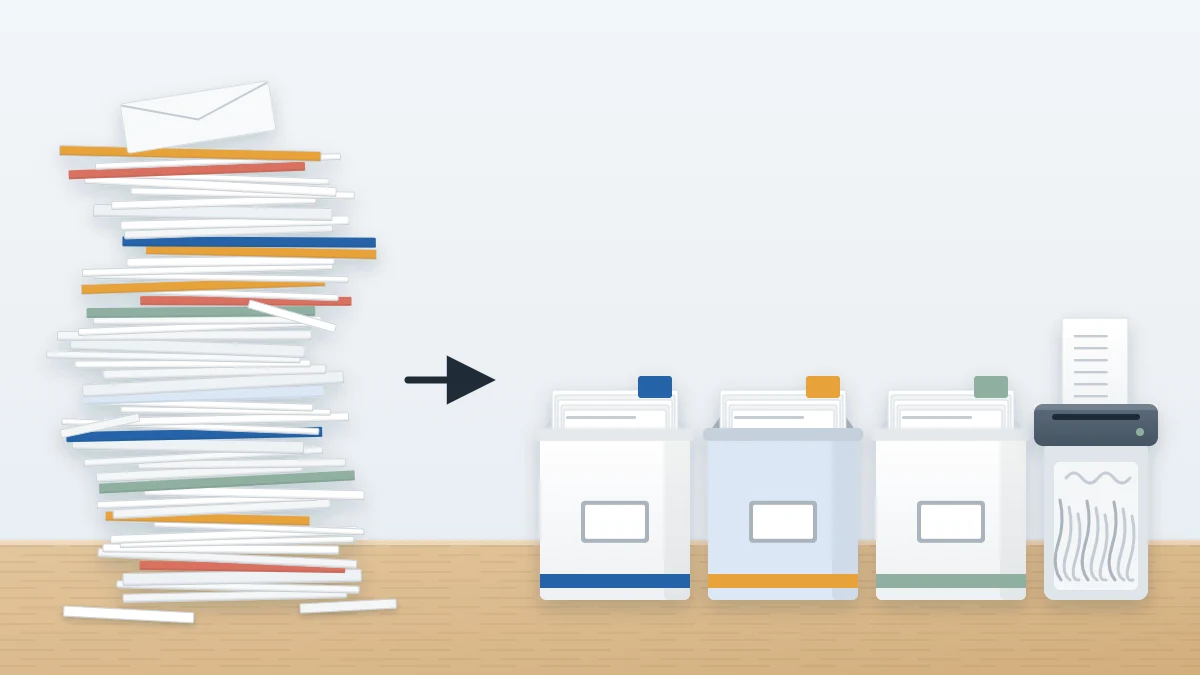
A backlog of paper rarely sits in one place. There is a pile on the desk, a bag behind the door, a box in the closet marked “to sort” and a drawer that no longer shuts. Each was set aside on a busy day, and together they feel like a job with no starting point.
Paper clutter on this scale is not cleared in one heroic afternoon. It is cleared in short sessions that each do one simple thing: gather, remove the obvious recycling, then sort what remains into a few broad boxes. Detailed filing waits until the end, when there is far less paper left to file.
Gather every pile into one place
Before sorting anything, collect it. Walk through the home with a box and bring every loose pile, bag and stack of paper to one spot: a table you can leave covered for a while, a corner of the office floor or a row of boxes along a wall.
- Keep each pile roughly intact and in order as you move it. Piles are usually layered by date, which helps later.
- Do not include paper that is already filed in labeled folders. That is not backlog.
- Stand the boxes side by side so you can see the full amount.
Set up the sorting station
You need a cleared surface and a small set of containers within arm’s reach:
- a large recycling bag or bin
- a box or bag marked “shred”
- four to six open boxes, lids off, for broad categories
- sticky notes and a marker for temporary labels
- a lidded box marked “unsorted”
Leave staples and paper clips in place for now. Removing them slows the sort, and you only need to do it for the papers you end up keeping.
Start with the newest paper
It is tempting to begin with the oldest box and work forward. Go the other way. The newest pile is the one most likely to hold something that still needs an answer, and it is the paper you will be asked about first.
Older piles are also faster. Much of what was undecided long ago has since settled itself: the offer has expired, the event has passed, the newer statement has replaced the old one. Leaving those until last means many of them can be dealt with in seconds.
First pass: pull out the obvious recycling
The first pass is fast and asks one question of each item: is this plainly not needed? You are not reading, only recognizing.
- Take a stack about as thick as your thumb.
- Open any sealed envelopes and unfold the contents flat.
- Drop outer envelopes, inserts, flyers, catalogs, expired coupons and duplicate copies into the recycling.
- Put anything showing a name, address, account number or other personal details that you are discarding into the shred box instead.
- Lay everything else, flattened, in a single “remaining” stack.
- Repeat with the next thumb-thick stack.
This pass often removes a large share of the volume, because so much of a paper pile is packaging and advertising. Stop the session when the timer goes, not when the pile ends.
Second pass: sort into broad categories
Now take the remaining stack and deal it out like cards into the open boxes. Use only a few wide categories that match how your household thinks about its paper. A common set is:
| Box | Typical contents |
|---|---|
| Needs action | Forms to fill in, letters to answer, anything with a date ahead |
| Home and household | Paperwork about the home, utilities, appliances and manuals |
| Money and accounts | Statements, bills and receipts |
| Work | Papers from a job or business |
| Personal and family | Health, school, certificates and records |
| Keepsakes | Cards, letters, children’s drawings |
Label each box with a sticky note. If a paper could go in two boxes, pick the one where you would look for it first and move on. Speed matters more than precision at this stage.
Keep the “needs action” box apart from the rest and look through it at the end of every session, so nothing with a deadline stays buried.
This guide does not say how long any paper should be kept. That depends on what the document is and where you live. For anything you are unsure about, check official guidance or ask a qualified professional before discarding it, and leave it in its category box meanwhile.
Shred in batches
Feeding a shredder one sheet at a time as you sort breaks your rhythm. Let the shred box fill and run it as a separate task.
- Follow the shredder’s instructions for how many sheets to feed at once and how long it can run before a rest.
- Remove clips and anything else the instructions say the machine cannot take.
- Empty the bin before it is packed full.
- With no shredder at home, keep the box closed until you can use a community shredding event or a local shredding service.
Tip
Shredding is a good job for the end of a session, when you are too tired to make decisions but can still feed paper into a machine.
Contain what is left between sessions
A backlog cleared over several sessions needs to be shut away tidily in between, or it spreads again.
- Put all paper not yet through the first pass into the “unsorted” box, newest on top.
- Write today’s date on a sticky note on the lid, along with a line such as “first pass done to here”.
- Stack the category boxes with their labels facing out.
- Take the recycling out.
If paper is only one of several kinds of clutter in the room, fit these sessions into the wider zone-by-zone plan for home office decluttering.
From boxes to files
When the unsorted box is empty, the backlog is gone. What you have instead is a handful of category boxes, and each is small enough to handle.
Go through one category box at a time with the four-pile method in how to organize paperwork, which catches anything the fast passes let through. Papers you are keeping then move into folders. The steps for containers, categories and tabs are in the guide to setting up a home filing system.
Stop new piles from forming
- Choose one landing spot for all incoming paper, such as a single tray, and put nothing anywhere else.
- Open mail beside the recycling bin, so envelopes and inserts never reach the tray.
- Empty the tray on a regular day each week.
Frequently asked questions
Should I start with the oldest or the newest paper?
Start with the newest. Recent paper is the most likely to need a reply or an action soon. Older piles tend to go faster, because many of the items in them have since been replaced by newer versions or are plainly out of date and need little thought.
How many categories should I sort a paper backlog into?
About four to six broad ones, such as needs action, home and household, money and accounts, work, personal and family, and keepsakes. Fine detail slows the sort and can wait until you set up folders. If a paper fits two boxes, choose where you would look first.
What should I do with paper I have not sorted when the session ends?
Put it all into one lidded box marked unsorted, with the newest paper on top and a dated note on the lid saying how far you got. Stack the category boxes with labels facing out and take the recycling out, so the room is usable until the next session.