How to Set Up a Home Filing System That Stays Usable
Build a physical filing setup that is quick to file into and quick to search: match the container to your volume, use broad categories with a few subfolders, label consistently and keep an index card.
At a glance
What you need
- File box, file drawer or binders
- Hanging folders and interior folders
- Tabs or adhesive labels
- One pen or a label maker
- Index card
A home filing system fails in one of two ways. Either it is so loose that every search means leafing through a whole box, or it is so detailed that filing a single sheet feels like a chore and the paper waits in a pile instead. A usable system sits between the two: broad enough to file into in seconds, ordered enough to find a paper in under a minute.
This guide covers the physical setup, from choosing a container to labeling tabs. It assumes the paper is already sorted into rough groups. If it is not, start with the four-pile method for organizing paperwork at home and come back with your “file” pile.
What to gather
- Your sorted papers, in their rough groups
- A container matched to the volume (see the next section)
- Hanging folders and interior folders, or binders with dividers
- Tabs or labels and one pen or a label maker
- An index card
Choose the container to match the volume
Stack all the paper you intend to file and measure the height of the stack. Then choose a container with roughly half as much space again, because folders, tabs and breathing room all take up width.
| Container | Suits a stack of about | Good to know |
|---|---|---|
| Desktop file or accordion file | A few inches (under 10 cm) | Fine for one person with little paper |
| Portable file box with rails | Up to the depth of the box | Takes hanging folders; lifts onto a shelf or into a closet |
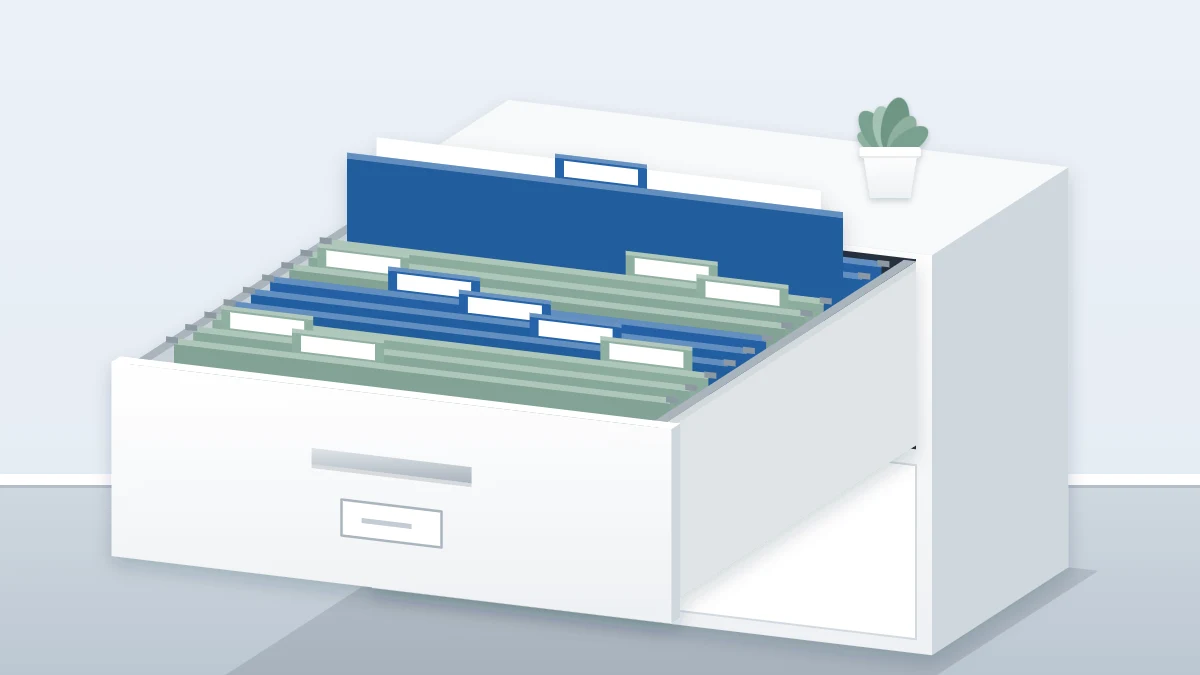
| File drawer with hanging folders | One drawer’s depth or more | Easiest to file into daily; needs a drawer that opens fully |
| Ring binders with dividers | Any, split by subject | Best for papers read in order, such as manuals or a course |
Measure your own drawer, shelf or closet before buying anything. If you have no room for a drawer or cabinet, the roundup of paper storage ideas without a filing cabinet compares compact alternatives.
Step by step: build the system
- Settle the broad categories. Lay the groups out and name each in one or two words: Home, Vehicle, Medical, Insurance, Bank, Work, School, Manuals, Personal. Aim for no more than about ten. Each gets one hanging folder, or one binder.
- Add subfolders only where a category is thick. If a category holds more than about a finger’s thickness of paper, split it into interior folders inside the hanging folder: “Medical” might hold one per family member, “Home” one each for utilities, repairs and property papers. Thin categories stay as a single folder.
- Label the tabs consistently. Use the same pen or label style, the same wording pattern and the same tab position for each level, for example category tabs on the left and subfolder tabs on the right. The guide to home office labels covers wording and materials.
- Order the drawer by use, not by alphabet. Put the two or three categories you open most at the front, where the drawer needs to open only a hand’s width. Rarely opened categories go at the back.
- File each paper at the front of its folder. The newest sheet always goes in front of the last one. The folder then runs newest to oldest without any effort, and the paper you are most likely to need is the first you see.
- Leave space in every folder and in the drawer. Stop when a folder is about three-quarters full and when you can still slide your hand between the hanging folders. A drawer packed tight is one nobody files into.
- Write the index card. List the categories in drawer order, with subfolders beneath each. Stand the card at the very front of the drawer or tape it inside the box lid.
Why the index card matters
The card does three jobs. It tells you where a paper belongs when you are unsure, so you do not create a second folder for something that already has one. It lets another person in the household file or find something without asking. And it shows the whole structure at a glance, which makes it obvious when the list has grown too long.
Update the card in pencil whenever you add or merge a folder.
How to tell the system is too detailed
Over-division is the most common reason filing stops. Watch for these signs:
- Many folders hold only one or two sheets.
- You hesitate between two folders when filing a single paper.
- You have ever found the same kind of document in two different folders.
- The index card runs to a second side.
- A stack marked “to file” sits on top of the cabinet.
The cure is to merge. Combine thin subfolders back into their parent category and re-label. Searching a slightly fatter folder takes a few more seconds; a system that is not used costs far more.
The opposite problem is rarer and easy to spot: one folder so fat it will not close. Split that folder alone into two or three subfolders and leave the rest as it is.
Tip
Keep a few empty, unlabeled folders at the back of the drawer with a blank tab in each. When a new subject turns up, its folder is ready in ten seconds, and the paper does not wait in a pile for supplies.
Keeping the folders from overfilling
Once or twice a year, go through the thickest folders and remove what you no longer need. How long any paper should be kept depends on what it is and where you live, so check official guidance or ask a qualified professional when you are unsure; this guide deals only with where the paper sits while you have it.
Anything you do discard that shows personal details goes through the shredder before it goes to recycling. Older papers that you must keep but never consult can move out of the working drawer into a lidded, labeled box on a low shelf, which frees the drawer for current material.
Adapting the setup
No file drawer: a portable file box with rails works exactly like a drawer. Store it where you can lift the lid without moving anything else, or it will not get opened.
Binders instead of folders: use one binder per broad category, dividers for the subfolders, and add new pages at the front of each section. Label the spine in the same position on every binder.
Two people filing: either give each person a folder color within shared categories or split the drawer front and back. Put both arrangements on the same index card.
Frequently asked questions
What categories should a home filing system have?
Use broad ones named the way you think of them, such as Home, Vehicle, Medical, Insurance, Bank, Work, School, Manuals and Personal. Around ten or fewer is manageable for most households. Add subfolders only inside categories that grow thicker than about a finger's width.
Should files be in alphabetical order?
Not necessarily. In a home system with about ten categories, ordering by use works better: the folders you open most often sit at the front of the drawer where they are easiest to reach. An index card at the front lists the order so anyone can find a category quickly.
Are hanging folders better than binders?
Hanging folders are quicker for everyday filing because a sheet drops in without punching holes. Binders suit papers you read in sequence or carry around, such as manuals or course notes. Many homes use both: a drawer or box of hanging folders for general papers and a binder or two for special subjects.