Paper Storage Ideas: 8 Options When You Have No Filing Cabinet
Eight compact ways to store paper without a filing cabinet, compared by what each holds, the space it needs and what it suits, plus how to keep blank printer paper flat and dry.
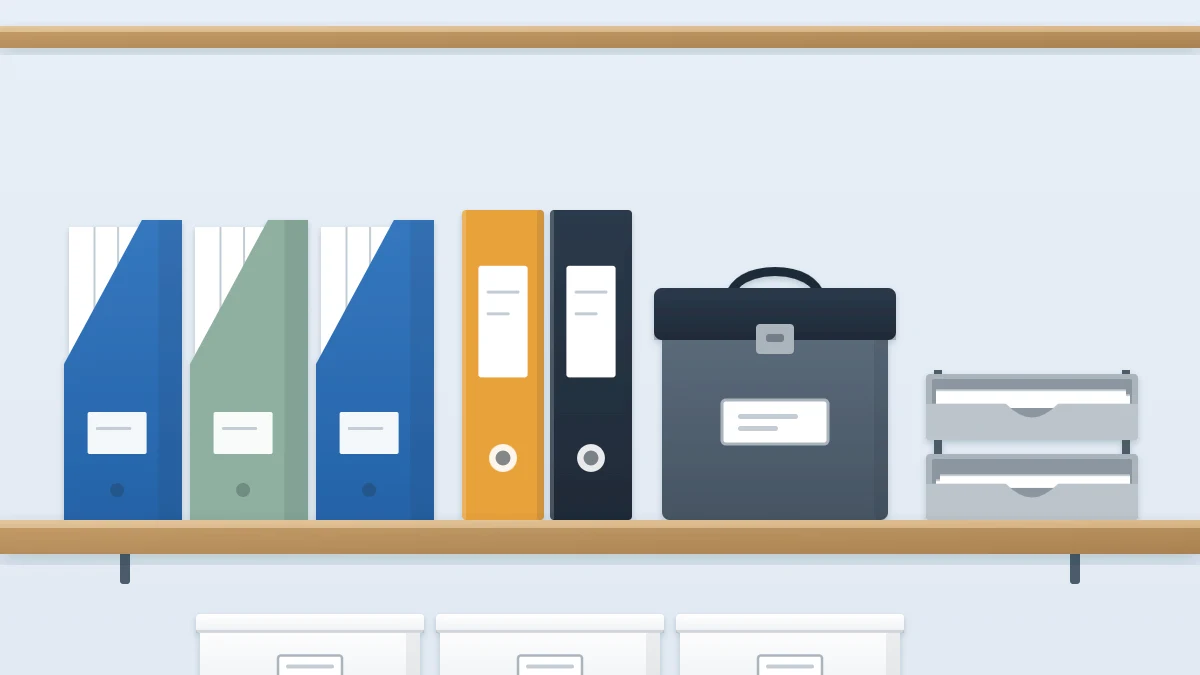
A filing cabinet is only one way to keep paper in order, and for many homes it is the wrong one: too large for the room, or far more capacity than a few folders need. The paper storage ideas below are all compact, and most sit on a shelf or a corner of a desk you already have.
Each option suits a different amount of paper and a different pattern of use. Start with the comparison table, then read the notes on the two or three that match your space.
The eight options compared
| Option | Holds | Space needed | Best for |
|---|---|---|---|
| Portable file box | A full set of household folders | One shelf or closet floor spot | General filing, weekly use |
| Desktop vertical file | Five to ten slim folders | A desk corner | Current work, daily use |
| Magazine files | One subject each | Shelf space, a hand’s width each | Catalogs, manuals, thick sets |
| Ring binders with dividers | One subject, pages in order | Shelf space, upright | Papers read in sequence |
| Accordion file | A small amount in many categories | A drawer or shelf gap | Very little paper, or papers that travel |
| Stackable letter trays | Loose sheets, a short stack each | A desk or shelf footprint of one sheet | Paper in motion: in, out, to file |
| Lidded document boxes | Thick stacks, flat | A low shelf or closet shelf | Papers kept but rarely opened |
| Wall pockets | A few folders or the day’s mail | A patch of wall or a door | Tight rooms, incoming paper |
Options for paper you touch every day
Desktop vertical file
A stepped or slotted holder that stands folders on edge with their tabs visible. Keep it for current work only, and move finished folders on to longer-term storage so the file does not become a second pile.
Stackable letter trays
Trays are for paper that is passing through, not paper being kept. Two is usually the limit: one for incoming sheets and one for things to file. Label the front edge of each, and empty both weekly.
Wall pockets
A wall pocket holds a few folders or envelopes upright against the wall or the back of a door, which helps when there is no free surface at all. Over-door versions hang from the top of the door without fixings. Keep the contents light: current folders and mail, not archives.
Safety note
For wall pockets or a wall shelf, follow the manufacturer’s instructions and stated limits and use fixings suited to your wall type. If you rent, check the lease or ask the landlord before drilling, or choose an over-door or freestanding option. Paper is heavy in bulk, so full boxes and binders belong on low shelves.
Options for paper you use weekly or monthly
Portable file box
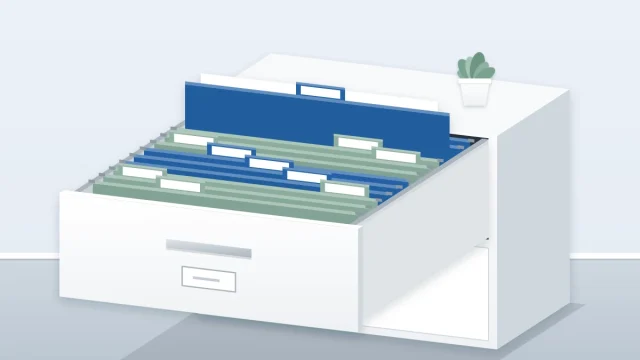
A lidded box with rails for hanging folders is the nearest thing to a cabinet drawer, in a form you can lift onto a shelf. One box holds the general papers of most households. Store it where the lid can open without moving anything else. For choosing categories and arranging folders inside it, follow the guide to setting up a home filing system.
Magazine files on a shelf
Upright magazine files turn a bookshelf into filing space. Give each one a single subject, such as appliance manuals, a child’s school papers or one project, and label the spine end. They suit thick or stapled material that slumps in a hanging folder. They are also a neat home for spiral pads and journals; see the guide on how to organize notebooks for that use.
Ring binders with dividers
Binders keep pages in a fixed order and let you flip through them like a book, which suits manuals, course material and records you add to in sequence. They are slower for everyday filing because each sheet needs punching or a sleeve. Use one binder per subject, tabbed dividers inside, and a label in the same place on every spine.
Accordion file
An expanding file with a dozen or so pockets and a flap closure holds a small household’s papers in the space of one thick book. Label each pocket tab, and treat its capacity as the limit: when the flap no longer closes, it is time to thin the contents or move up to a file box.
Options for paper you rarely open
Lidded document boxes
Flat boxes sized for letter paper keep older papers clean and together. Sort the contents into labeled folders before they go in, so a later search means lifting out one folder, not the whole stack. Label the short end of the box, which is the side that faces out on a shelf, and store the boxes low, since a full one is heavy to lift down from overhead.
How long any paper needs to be kept depends on what it is and where you live. Check official guidance or ask a qualified professional before deciding what goes into long-term boxes and what can be shredded.
Match the option to how often you touch the paper
The most common mistake is choosing storage by looks or capacity. Choose by frequency instead.
- Daily: open and within reach of the chair. Desktop file, a tray, a wall pocket. No lids, nothing to unstack.
- Weekly or monthly: a step or two away, one motion to open. File box, magazine files, binders, accordion file.
- Rarely: closed, labeled and out of the way. Document boxes on a low shelf or closet shelf.
A typical combination is a desktop file for current folders, a portable file box for general papers and one or two document boxes for older ones. In a very small workspace, the daily option may be all that stays in the room, with the others stored elsewhere in the home; the guide to small home office organization has more on dividing storage that way.
Storing blank printer paper
Unused paper needs different care from filed paper, because its job is to feed cleanly through a printer.
- Keep it flat. Lay reams flat on a shelf, never on edge, so the sheets do not curl.
- Keep it wrapped. Leave a ream in its wrapper until needed. Once opened, fold the wrapper closed or move the remainder to a lidded box.
- Keep it dry and out of direct sun. Avoid spots beside a window, a radiator or an outside door, and do not store it directly on a floor that may be damp.
- Keep the stack short. Two or three reams near the printer is plenty; reams at the bottom of a tall stack are awkward to pull out.
Frequently asked questions
What can I use instead of a filing cabinet?
A portable file box with hanging folders does the same job as a cabinet drawer and sits on a shelf or closet floor. For smaller amounts, an accordion file or a desktop vertical file is enough. Magazine files and ring binders work well for thick sets such as manuals.
How should I store blank printer paper?
Lay reams flat, in their wrappers, on a shelf that is dry and away from direct sun, radiators and damp floors. After opening a ream, fold the wrapper shut or move the remaining sheets to a lidded box. Keep only two or three reams in a stack so the lower ones are easy to reach.
Where should I keep papers I rarely need?
In lidded document boxes, sorted into labeled folders first, with the box labeled on the end that faces out. Store them on a low shelf, because full boxes of paper are heavy to lift from overhead. They can live in a closet outside the office to free working space.