How to Organize Notebooks, Planners and Notepads
Gather every notebook, sort them into in use, finished and blank, keep one current notebook per purpose at the desk and store the rest upright, dated and labeled so any of them can be found later.

Notebooks multiply quietly. One is started for a project, another is grabbed because the first was in a different room, a third arrives as a gift, and soon there are a dozen around the office, each a third full. Working out how to organize notebooks is mostly a matter of deciding which few are in use and giving the rest two clear storage places.
This guide deals only with the physical side: where notebooks, planners and notepads sit, how they are marked and how to find an old one later. What you write in them, and how, is up to you.
Gather every notebook into one place
Start by collecting them all. Check the desk and its drawers, shelves, bags, the bedside table, the kitchen and the car. Include planners, legal pads, spiral pads and the small pocket books that hide in coat pockets.
Sort into three groups
Open each notebook briefly and place it in one of three stacks.
| Group | How to recognize it | Where it will live |
|---|---|---|
| In use | You have written in it recently and will again | On or beside the desk |
| Finished | Full, or belonging to something that has ended | Upright on a shelf or in a magazine file |
| Blank | Unused, or with only a few pages used | Together with your paper stock |
The awkward ones are partly used notebooks that you stopped writing in. Decide each on its contents. If the written pages matter, treat it as finished even though pages remain. If they do not, carefully remove the used pages, recycle them (shredding first any that show personal details) and put the notebook in the blank stack.
Keep one current notebook per purpose
Look at the in-use stack and name the purpose of each notebook in a word or two: work notes, household lists, a course, a journal. Where two notebooks share a purpose, choose one to continue and move the other to the finished stack, even if it has blank pages left.
One notebook per purpose is the rule that stops the scatter from coming back. You always know which book to pick up, and a new notebook is only started when the old one for that purpose is full.
- Mark the purpose on the cover. A small label or a line of pen in the same corner of each is enough.
- Keep the number small. Most desks manage well with two to four current notebooks. More than that, and they begin to pile.
- Planners count. A dated planner is one of the current set and lives with them, not on a different surface.
Give the current notebooks a spot on the desk
Current notebooks need a fixed place within reach, or they drift across the surface.
For the open notebook
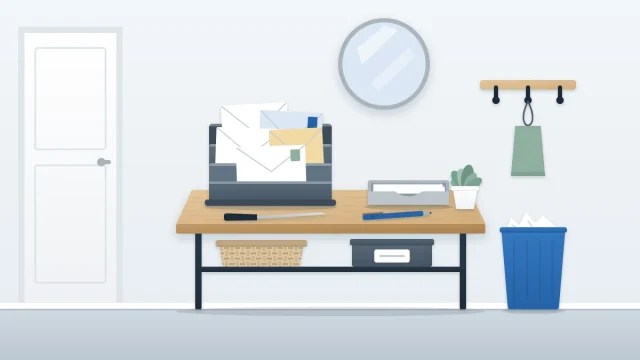
The notebook you write in through the day can sit on a small stand or easel beside the keyboard, which holds it at an angle and takes up less depth than a book lying flat. A shallow tray the size of the notebook works too: the open book and its pen live in the tray, and the pair can be lifted away together when you need the space.
For the others
Stand the remaining current notebooks upright in a desktop file holder or between two small bookends at the back of the desk, spines or top edges facing you. Upright storage lets you pull out one without lifting the rest, which a flat stack never allows. Keep a single notepad by the keyboard and the spare pads with the blank stock.
Store finished notebooks upright and marked
Finished notebooks are reference material. The aim is to be able to find the right one in a minute or so, long after you have forgotten what it looks like.
- Mark each one. Write a date range and a subject where it will show when shelved, for example “Mar to Sep 2025, kitchen renovation”. On a bound notebook, use a label on the spine. A spiral notebook has no spine to write on, so put the label on the front cover near the top edge, where it shows when you tip the book forward.
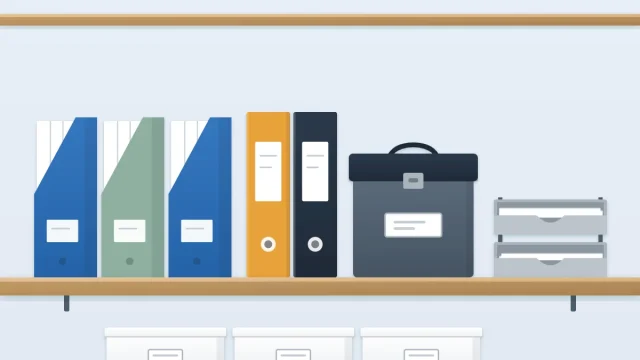
- Stand them upright. Line them up on a shelf between bookends, in date order within each subject. Thin or floppy notebooks stand better inside a magazine file, one file per subject or per year.
- Label the magazine file. The file’s end label carries the subject and the span of dates inside, so you can choose the right file before pulling anything out.
- Choose a shelf by use. Notebooks you still consult go at a height you can reach from the chair or in one step. Older ones can go higher or in a lidded box. The guide to organizing home office shelves by reach and use explains how to assign shelf heights.
If shelf space is short, magazine files are only one of several compact containers that suit bound paper. The comparison of paper storage ideas covers boxes and other options that work for finished notebooks as well as loose sheets.
Tip
Mark a notebook on the day you start it, not the day it is finished. Write the subject and the start date on the label straight away, and add the end date when you retire it. A notebook labeled from the first page never becomes a mystery book.
Keep blank stock together in one place
Unused notebooks and pads are supplies, and they belong with the rest of your stock, not on the desk. Put them all in one container: a lidded box, one shelf section or a deep drawer. Stand them on edge, sorted roughly by size, so you can see each cover.
If your supplies are spread around the house, the guide to office supply storage ideas shows how to set up one supply home for everything.
Remove and file the loose inserts
Notebooks collect loose paper: receipts, business cards, printed handouts, folded letters, sticky notes that have lost their grip. Left inside, these fall out when the book is shelved and are very hard to find later.
- Shake each notebook gently over the table before it is stored and gather what falls out.
- Loose papers that matter go into your filing folders under their subject, exactly like any other document.
- Notes that belong with a particular page can be taped or glued onto that page along one edge.
- Everything else goes to recycling, or to the shredder if it shows personal details.
Frequently asked questions
How should I store old notebooks?
Upright, like books, on a shelf between bookends or inside magazine files. Label each spine or cover with a date range and subject before shelving, and group them by subject in date order. Upright storage lets you pull out a single notebook without unstacking the others.
What should I do with half-used notebooks?
Decide by the written pages. If they matter, label the notebook and shelve it as finished, even with pages left. If they do not, remove and recycle the used pages, shredding any with personal details, and return the notebook to your blank stock for a new purpose.
How many notebooks should stay on the desk?
One for each purpose you write for, which for most people means two to four in total, including a planner. Keep the one in use open on a stand or tray and the others upright in a file holder. Blank spares stay with your supplies until one is needed.