How to Set Up a Mail Station for Incoming Paper
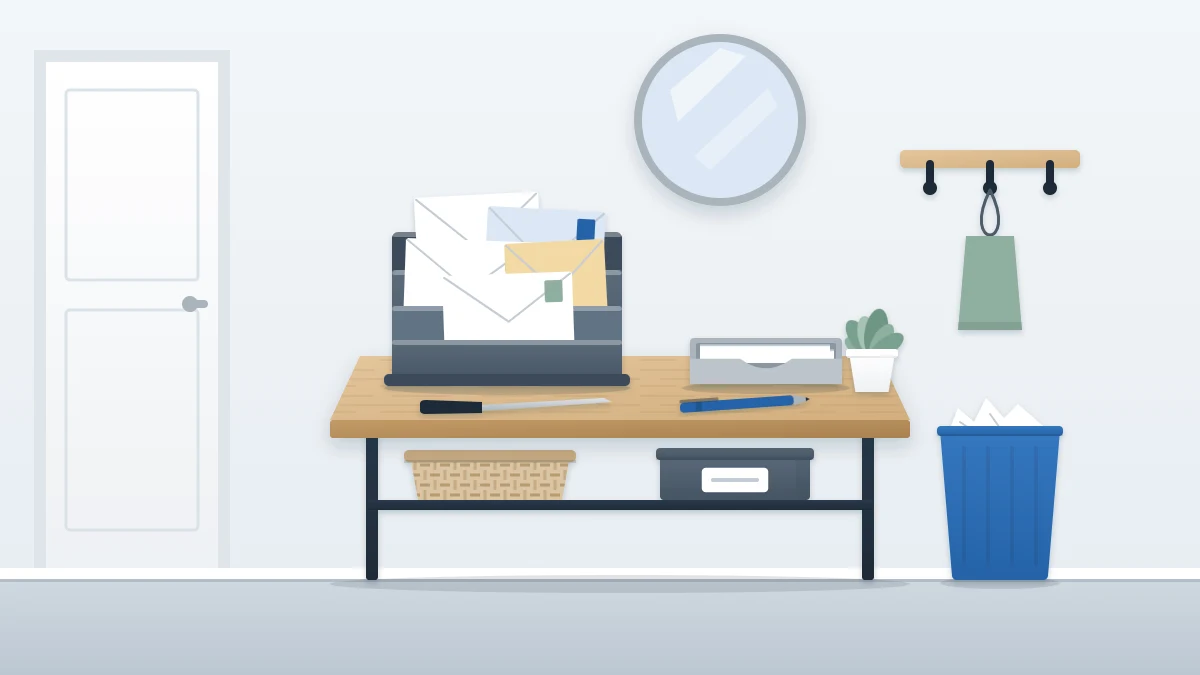
Give mail and loose paper one landing spot: an inbox tray, two or three labeled slots, a recycling bin and a shredding container within reach, plus a two-minute routine for opening it all.
At a glance
What you need
- Letter-size inbox tray
- Upright sorter with two or three slots
- Small recycling bin
- Marked container for shredding
- Letter opener and pen
- Labels
Mail spreads through a home because it has no first stop. It comes through the door, gets carried a few steps and is set down on the nearest flat surface: the kitchen counter, the stairs, the arm of a chair. A mail station gives all incoming paper one landing spot, with the few tools needed to open it and send each piece on its way.
The setup below takes about half an hour and occupies roughly the footprint of a sheet of paper or two. It also catches the other loose paper that enters a home: school forms, flyers, receipts and notes.
Choose the spot
The station has to be where paper actually arrives, not where it would look best. Follow the route you walk when you bring the mail in and find the first surface you pass. That is usually where the piles already form, and it is the right place.
- By the entrance: a console table, a shelf of a hallway unit or the end of a counter near the door.
- In the office: a shelf or the corner of a cabinet just inside the door, if mail is always carried straight there.
- Not on the desk itself. The desk is for paper you are working on. The station is for paper that has not been looked at yet.
Check that a small bin can stand on the floor beside or beneath the spot. If there is no room for a bin, choose somewhere else: the bin is half the system.
What to gather
- One inbox tray, letter size
- An upright sorter with two or three slots, or two or three magazine files
- A small recycling bin or basket
- A lidded container or sturdy bag marked for shredding
- A letter opener and a pen
- Labels for the slots
Measure the surface before choosing a tray and sorter, and check the depth in particular; a tray that overhangs a narrow shelf will get knocked.
Step by step: set up the station
- Clear the surface. Remove everything from the chosen spot and wipe it. Any paper already there goes into the new inbox tray once it is in place.
- Place the inbox tray at the front. This is where unopened mail and unsorted paper land. Nothing else goes in it.
- Stand the sorter behind or beside the tray. Label the slots. For most homes, three are enough: To act on, To file and one for other household members.
- Put the recycling bin within arm’s reach. If you have to walk to it, envelopes will be left on the surface.
- Set the shredding container next to the bin. Mark it clearly so it is never emptied into the recycling by mistake.
- Add the letter opener and pen. Stand them in a small cup or lay them in the front lip of the tray. They stay at the station.
- Tell the household. Show everyone the tray and the slot for their own mail. The station only works if all paper enters through it.
How to open mail at the station
The opening routine is what keeps the tray from becoming one more pile. Do it standing at the station, over the bin, daily or every other day. It takes a couple of minutes.
- Drop obvious junk straight in the bin. Flyers, catalogs you do not want and circulars addressed to no one go unopened into recycling.
- Open each remaining envelope. Take out the contents and unfold and flatten them.
- Remove the extras. Outer envelopes, return envelopes you will not use and advertising inserts go in the bin. Any piece you are discarding that shows your name with an address, an account number or similar personal details goes in the shredding container instead.
- Put each flattened item in a slot. Needs a reply, a payment or a signature: to act on. Needs keeping but no action: to file. Addressed to someone else: their slot.
- Leave the tray empty. If you cannot open the mail right now, it waits in the tray, and only there.
Move papers on at the weekly reset
The slots are a waiting area, not storage. Once a week, empty them:
- To act on: carry the contents to your desk and put them in your action tray or folders.
- To file: carry these to the filing box or drawer and put each in its folder.
- Other people’s slot: hand over anything not yet collected.
- Bins: empty the recycling and shred the contents of the shredding container before recycling them.
This fits naturally into the weekly part of a home office reset routine. What happens to the papers after they leave the station, including how to group the ones you keep, is covered in the guide on how to organize paperwork.
The station does not answer the question of how long to keep a document. That depends on what the paper is and where you live, so check official guidance or ask a qualified professional when you are unsure.
A wall pocket option for tight spaces
Where there is no free surface near the door, the station can go on the wall or a door instead. A set of two or three wall pockets does the work of both tray and sorter: the top pocket is the inbox and the lower ones are the slots. Hang the pen and letter opener in a small cup beside them, and stand a slim bin on the floor underneath.
An over-door pocket organizer needs no fixings and suits a closet or office door. Keep wall and door pockets for mail and a few thin folders only, and empty them weekly so they never carry a heavy load of paper.
Safety note
For wall pockets or any small shelf fixed to the wall, follow the manufacturer’s instructions and stated limits and use fixings suited to your wall type. If you rent, check the lease or ask the landlord before drilling, or choose an over-door or freestanding option. Keep heavy items low.
Adapting the station to your household
Several people: give each adult a labeled slot, or one slot per person in a different color. Shared mail goes to “to act on”. If two of you also share a workspace, the guide to shared home office organization explains how separate trays and colors carry through to the desk.
One person: two slots are enough, to act on and to file.
Children’s school paper: add one slot for forms that need signing and returning, placed low enough for a child to reach.
Frequently asked questions
Where is the best place for a mail station?
On the first surface you pass when you bring the mail in, usually near the entrance or just inside the office door. It needs room for a letter-size tray and a small sorter, and floor space beside it for a recycling bin. Avoid using the desk itself.
How many slots does a mail sorter need?
Two or three is enough for most homes: one for papers to act on, one for papers to file and one for mail belonging to other household members. A person living alone can manage with two. More slots than that tend to turn into long-term storage.
What should I do with junk mail?
Drop it into the recycling bin at the station without opening it. If a piece you are discarding shows your name with an address, an account number or other personal details, put it in the shredding container instead and shred it before it is recycled.