Shared Home Office Organization: Two People, One Room
How two people can share one office or one desk: a surface and a drawer each, shared supplies in one agreed place, a color per person and separate inbox trays.

When two people use one room, most of the friction is physical. A stapler goes missing, one person’s papers drift across the desk, nobody is sure whose charger is whose, and the surface is never clear because each assumes the other will tidy it.
A shared home office runs more smoothly when the space is divided as plainly as a shared kitchen: this shelf is yours, this one is mine, and this one belongs to both of us. The steps here cover two adults working side by side, a couple taking turns at one desk, and a family desk used for household paperwork and homework.
Give each person a surface of their own
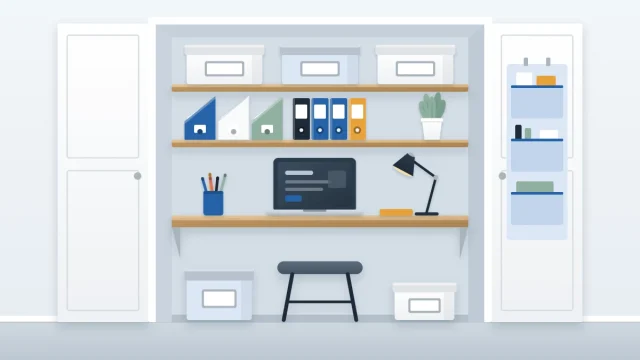
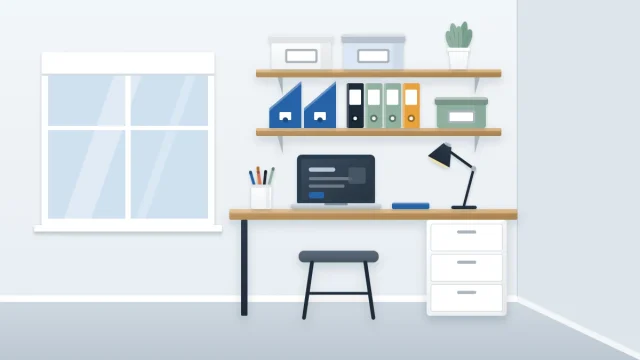
Each person needs a patch of desk that nobody else puts things on. With two desks that is simple. With one long desk, agree on a dividing line and mark it with something physical: a lamp, a small drawer unit under the middle, or the edge of each person’s desk mat.
Whatever sits on your side is yours to arrange and yours to clear. The line also settles where shared objects go, which is on neither side. A printer, a paper tray or a box of supplies belongs on a separate shelf or cabinet, not in the middle of the desk where it slowly becomes one person’s problem.
If the room is tight for two, the principles for small home office organization help you decide what can leave the room altogether.
One personal drawer or box each
Personal items need a closed home so they do not spread. Give each person one container of the same size:
- a drawer each in a shared drawer unit, or
- a lidded box each on a shelf, or
- one tier each on a rolling cart.
Favorite pens, a notebook, earphones, reading glasses and personal papers in progress go in there. The container sets the limit. When it is full, its owner sorts it. Nobody else opens it, and nobody else tidies things into it, which keeps the arrangement fair and stops well-meant “helping” from hiding someone’s work.
Put shared supplies in one agreed place
Scissors, tape, the stapler, envelopes, stamps, printer paper and spare ink are shared, so they get one home that both people can reach without leaning over the other’s chair. A shelf, a cabinet or the top tier of a cart works well.
- Collect every shared supply from both sides of the room.
- Remove duplicates you do not need. Two staplers are fine if each person uses one all day; four are not.
- Group what is left into a few open boxes or trays by type.
- Place them where both people can reach, and label each box so things return to the same spot.
- Agree one rule: shared items go back after use, not onto a personal surface.
If one tool is in constant demand, buy a second and make each a personal item. That is cheaper in effort than a daily search.
A color for each person
Color is the fastest way to show ownership without reading anything. Each person picks one color and uses it for folders, the label on their drawer or box, their inbox tray and the tags on their cables. A third, neutral color such as white or tan marks everything shared.
| Item | Person one | Person two | Shared |
|---|---|---|---|
| Folders | Blue | Green | Plain |
| Inbox tray | Blue label | Green label | White label, household |
| Drawer or box | Blue label | Green label | White label |
| Chargers and cables | Blue band | Green band | No band |
Keep the scheme to one color per person. More than that and nobody remembers the key. For wording and where to place the labels, follow the steps for building a set of home office labels.
Separate inbox trays
Paper is where shared rooms go wrong fastest, because a single pile mixes two people’s unfinished business. Use three trays or upright slots: one for each person and one for household paper that either of you may handle.
Incoming mail and printouts go straight into the right tray, never onto the desk. Each person empties their own. The household tray is emptied together or by whoever agreed to take that kind of paper. Stack the trays or stand them on the shared shelf so they do not use up desk space.
One shared charging spot
Chargers trailing across both halves of the desk are a common source of clutter and mix-ups. Move phone, tablet and earphone charging to one hard, uncovered surface near an existing outlet, with a marked position for each person and each cable tagged in its owner’s color.
Do not overload the outlet or power strip, and follow the manufacturer’s instructions for the strip and for every device plugged into it. The full setup, including what to do with the spare cables, is in the guide to a tidy charging station.
Agree on a clear surface at the end of the day
A shared room needs one common standard for how it is left. The simplest is physical and easy to check: at the end of the day, each side of the desk is clear except for the computer, the lamp and one pen cup.
- Papers in progress go into the owner’s tray or drawer.
- Shared tools go back to the shared shelf.
- Mugs and plates leave the room.
- Chargers return to the charging spot.
This takes a few minutes each and means whoever sits down first the next day starts with a usable desk.
When one desk is used at different times
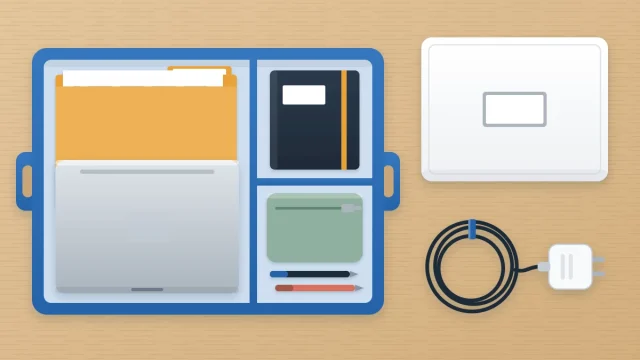
If two people take turns at a single desk, nothing personal can live on the surface. Give each person a caddy that lifts off: an open tote, a handled box or a deep tray holding their notebook, pens, earphones and current folder.
Tip
Choose caddies in each person’s color and give them a parking spot on a shelf beside the desk. Setting up means lifting one caddy onto the desk. Finishing means lifting it off again.
Only the shared equipment stays put: the monitor, keyboard, lamp and a pen cup of ordinary pens that belong to the desk. Each person’s chair height and screen angle will differ, so allow a moment at the start of each turn to adjust them.
Frequently asked questions
How do you divide a desk between two people?
Agree on a dividing line and mark it with something physical, such as a lamp, a drawer unit under the middle of the desk or the edges of two desk mats. Each person arranges and clears their own side. Shared equipment like the printer goes on a separate shelf, not on the line.
What supplies should be shared and what should be personal?
Share the things used occasionally by both people: scissors, tape, envelopes, stamps, printer paper and ink. Keep personal the things each person uses constantly or cares about, such as favorite pens, a notebook and earphones. If a shared tool is always in demand, get a second one and make each personal.
How can a family share one desk for work and homework?
Keep the surface free of personal items and give each family member a caddy or handled box that lifts on and off, in their own color, parked on a nearby shelf. Shared pens and a lamp stay on the desk, and each person's papers return to their own tray after use.