Home Office Organization: Where to Start
A practical order of first jobs for a messy or newly set-up home office: observe the room, clear the desk, give each category one home, store by use, then handle paper and cords.
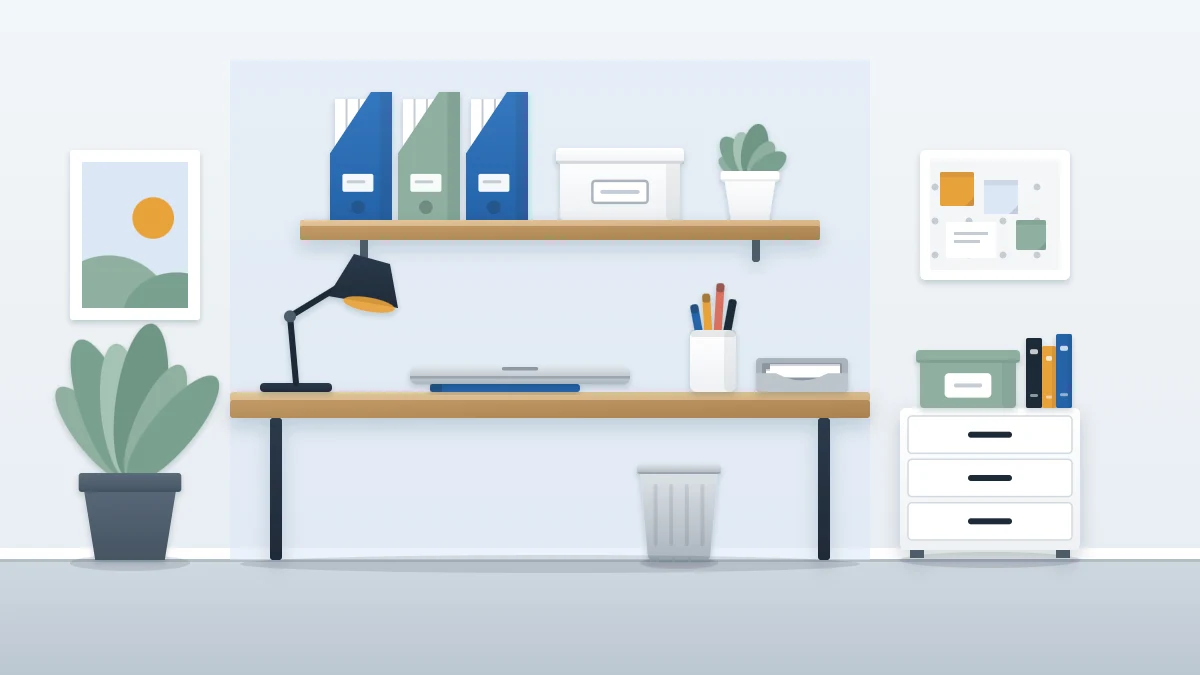
Home office organization usually goes wrong at the very first step: starting with whatever looks worst. A drawer gets emptied, a stack of new containers arrives, and two hours later the room looks the same because nothing had a place to go.
A better start is to work in a fixed order, from the surface you use every day outward to the things you touch once a season. This guide sets out that order, gives a rough time for each job and points to the detailed guide for each one, so you can stop after any step and still have a room that works better than it did.
Look at how the room is actually used
Before you move anything, spend about ten minutes in the doorway with a notepad. Write down what really happens in the room, not what the room was meant for.
- What do you do at the desk on a normal day: laptop work, handwriting, calls, opening mail?
- What else lives here: household papers, a printer, hobby supplies, another person’s things?
- Where do things pile up: a desk corner, the spare chair, the floor by the door?
- What do you get up to fetch more than once a day?
Piles are information. A pile marks the spot where something enters the room and finds no home waiting for it. The item you keep fetching is stored too far away. Both notes will decide where things go later, so keep the page.
A sensible order of first jobs
The times below are rough and assume an ordinary spare-room office. A room that has become general storage will take longer at every step.
| Job | Rough time | Done when |
|---|---|---|
| Observe and take notes | About 10 minutes | You have one page listing uses, piles and fetched items |
| Clear the work surface | About 30 minutes | Only daily items sit on the desk |
| Give each category one home | About an hour | Every group of items has a single named spot |
| Store by frequency of use | About 30 to 45 minutes | Daily items are within reach, rare ones are farther off |
| Sort the paper | About an hour for a first pass | Loose paper is in one tray or in sorted piles |
| Tidy the cords | About 20 to 30 minutes | Visible cords are gathered and off the walkway |
Clear the work surface first
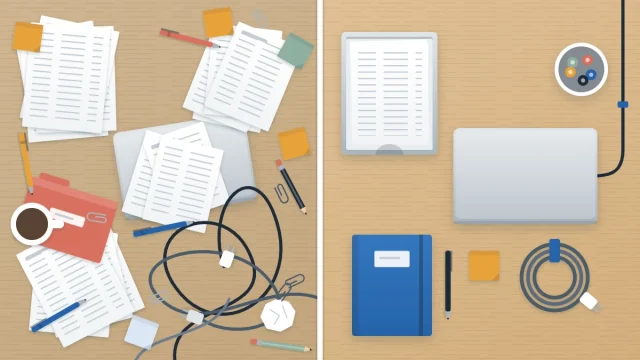
The desk comes first because it is the part of the room you use most and the part that shows a result fastest. Take everything off it and put the lot in one box or on the floor beside you. Wipe the surface while it is empty.
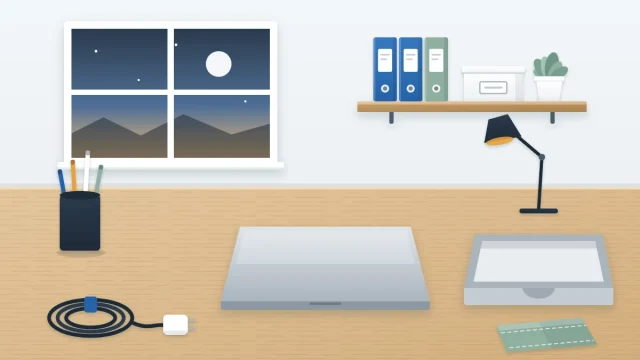
Then return only what you use every working day: the computer, a lamp, one cup of pens, one tray for paper, the notebook you are currently writing in. Everything else stays in the box for the next step. If you want specific ways to hold those few items, the list of ideas for keeping a desk surface clear covers trays, risers, hooks and the rest.
Do not sort the box yet. A clear desk gives you a place to sort on, which is the point of doing it first.
Give every category one home
Now work through the box and the rest of the room by category, not by location. Gather all the pens from every room, all the envelopes, all the spare cables, all the notebooks. Seeing a whole category at once shows how much you really own and how big its container has to be.
Each category then gets one home, and only one. Two homes for the same thing is how duplicates appear: you cannot find the tape, so you buy tape, and the first roll turns up a week later.
- Name the category plainly. “Envelopes and stamps” is a home. “Desk stuff” is not.
- Use containers you already own first. Shoeboxes, jars and trays are enough to test a layout. Buy better ones once you know the sizes you need.
- Leave some room. A box filled to the lid on day one will overflow by next month.
Store by how often you use things
With categories set, decide where each home goes by a single question: how often do you reach for it?
- Daily: on the desk or in its top drawer, reachable without standing.
- Weekly: a step or two away, on a shelf at a comfortable height or in a lower drawer.
- Monthly or less: across the room, on a high shelf if it is light or a low one if it is heavy.
- Almost never: out of the office altogether, if another closet can take it.
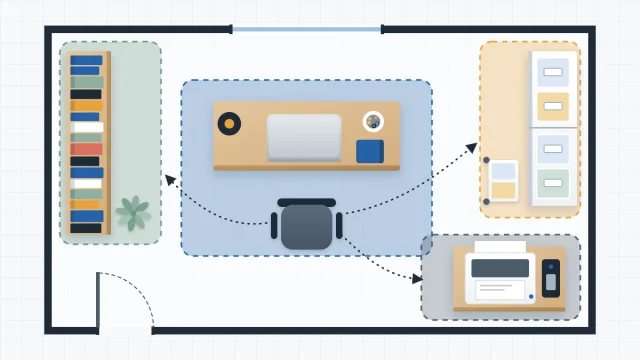
This is where the note about things you keep fetching pays off. Move those closer and move something you rarely touch out of the prime spot to make space. Laying the whole room out this way is a project of its own, and the guide to dividing a home office into work zones walks through it with a sketch.
Then deal with paper
Paper waits until now on purpose. It is slow to sort, and it needs a clear surface and somewhere to go afterward, both of which you now have.
For a first pass, aim only to get loose paper into one place and to set up one tray where new paper lands. The full method for sorting paperwork into four piles takes it from there. Whatever you recycle, shred anything that shows personal details first.
Finish with cords
Cords come last because furniture and equipment have to be in their final places before it makes sense to tidy what connects them. Keep the job modest: unplug, remove any cord that no longer serves a device you own, and gather the rest loosely with soft reusable ties so they run along the back of the desk and stay out of walkways.
Safety note
Do not overload a power strip or outlet, and follow the manufacturer’s instructions for the strip and for each device plugged into it. Stop using and replace any cord that is frayed, cracked or unusually hot.
If the room simply holds too much
Sometimes the order above stalls at step three because there is more in the room than it can store, however cleverly you arrange it. That is a different job: removing things, not placing them.
In that case pause here and work through a zone-by-zone decluttering plan first, then come back to categories and homes. Organizing what remains will go far faster, and you will buy fewer containers than you expected.
Frequently asked questions
What should I organize first in a home office?
Start with the desk surface. It is the part of the room you use most, it shows a result quickly, and once it is clear you have a flat place to sort everything else. Take everything off, wipe it, and put back only the items you use every working day.
Should I buy storage containers before I start?
No. Sort your things into categories first, using boxes, jars and trays you already own to test the layout. Once you can see how much each category really holds and where it will live, measure that spot and buy containers to fit. Buying first usually leaves you with the wrong sizes.
How long does it take to organize a home office?
A first pass through an ordinary spare-room office takes roughly three to four hours in total, and it can be split across several days because each step stands on its own. A room that has been used as general storage takes longer and is better decluttered before you organize it.