Desk Organization Ideas: 12 Ways to Clear Your Work Surface
Twelve practical ways to get things off your desk, from a monitor riser and a single paper tray to an under-desk hook and a rolling cart, with what each one solves and what it needs.
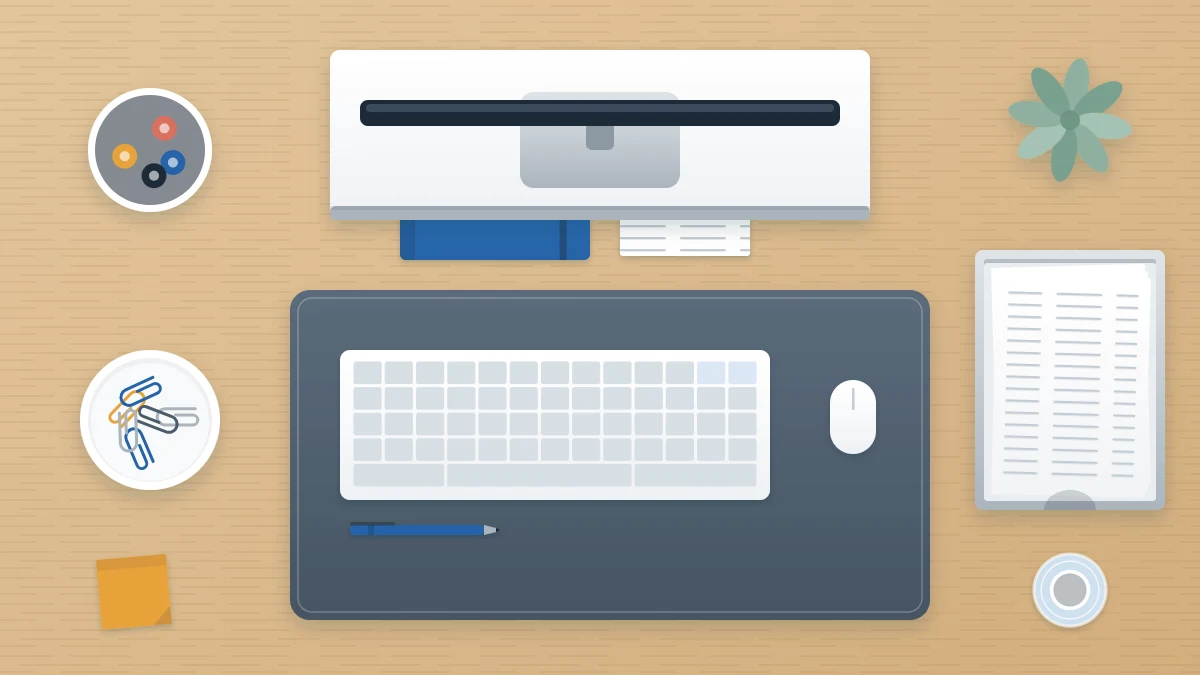
A desk stays clear when each thing on it has a holder and everything else has a place just off it. The twelve desk organization ideas below each solve one specific cause of surface clutter, and each note says what the idea needs so you can tell at once whether it suits your desk.
You do not need all twelve. Pick the two or three that match what actually piles up in front of you, try them for a week, then add another if a gap remains.
Raise things off the surface
1. A monitor riser with storage underneath
Solves: a keyboard, notebook or laptop with nowhere to go when not in use. Needs: a riser tall and wide enough for your screen’s base, with an open gap below. Slide the keyboard or the current notebook under it at the end of the day. Check your screen’s manual for how its stand should be supported.
2. A shelf just above the desk
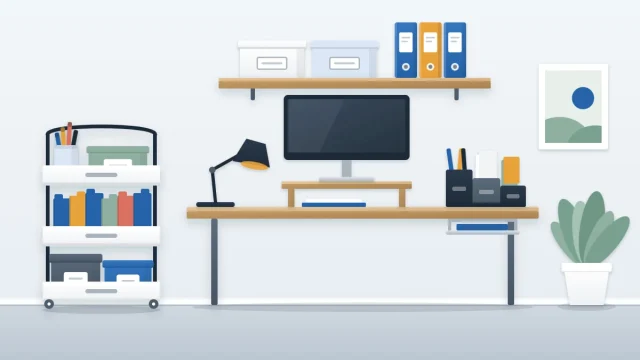
Solves: reference books, a speaker or a small plant taking up desk space. Needs: either a freestanding desktop shelf unit that sits on the back of the desk, or a wall shelf within reach of the chair. Keep it for light things you look at or grab often.
Safety note
For any wall shelf, follow the manufacturer’s instructions and stated limits and use fixings suited to your wall type. If you rent, check the lease or ask the landlord before drilling, or choose a freestanding desktop shelf. Heavy items belong on low shelves, not above the desk.
Give paper one place
3. One tray for active papers
Solves: loose sheets spreading across the desk. Needs: a single letter tray at the far corner on your non-writing side. One tray, not a stack of three; a single tray shows its level and has to be emptied.
4. A vertical file for current folders
Solves: folders lying in a heap where only the top one is visible. Needs: a desktop file holder with a few upright slots. Stand each current folder on its edge with the tab up. Limit it to work in hand this month; finished folders go to the filing drawer.
5. A closing-time tray
Solves: a desk in a shared room that has to look clear in the evening. Needs: a shallow tray or lidded box big enough for the notebook, pens and papers in use. At the end of the day everything loose goes in, and the tray moves to a shelf. In the morning it comes back and you carry on where you stopped.
Contain the small tools
6. A pen cup limited to working pens
Solves: a cup so full that the pen you want is at the bottom. Needs: one cup and a limit of roughly a handful of pens, a pencil and a highlighter. Test them and move the rest to a backup box. The guide on how to organize pens and pencils explains the sorting.
7. A drawer for daily tools
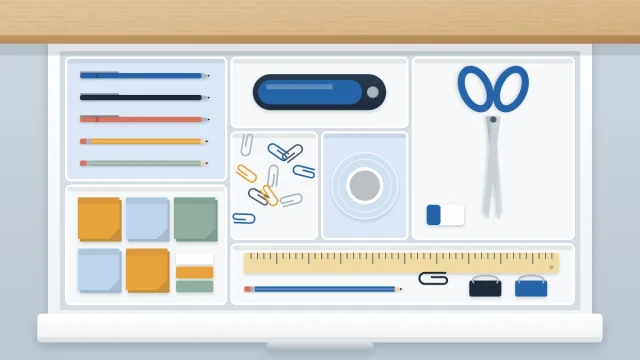
Solves: scissors, stapler and tape living on the surface. Needs: the top drawer, cleared of everything else and divided into compartments so each tool has a fixed slot. See how to organize desk drawers for planning the layout.
8. A small catch-all dish
Solves: paper clips, a spare key, earbuds and coins scattered near the keyboard. Needs: one saucer-sized dish. Its small size is the point: when it is full, empty it into the proper homes.
Use the edges and the underside
9. An under-desk hook
Solves: a bag on the floor or headphones on the desk. Needs: a clamp-on hook, or a stick-on hook used as its maker directs and within the limit it states, placed under the desk edge on the side away from your knees. Keep it for one light item.
10. A cable holder at the desk edge
Solves: charger ends sliding off the back of the desk every time you unplug. Needs: a small weighted or adhesive holder with slots, set at the back edge. Each cable end rests in a slot, ready to pick up. For the cords behind and under the desk, follow the guide to desk cable organization.
Mark the clear zone and add overflow
11. A desk mat that marks the clear zone
Solves: the work area slowly shrinking as items creep inward. Needs: a mat or blotter about as wide as your keyboard and mouse or an open notebook. The rule is simple: nothing is stored on the mat. Whatever sits on it at the end of the day gets put away.
12. A rolling cart beside the desk
Solves: a desk with too little storage for supplies, files or a printer’s paper. Needs: floor space about the width of a chair beside or behind you. Use the top tier for things used daily and the lower tiers for heavier stock. A cart is also the main answer for a table with no storage at all, as covered in the guide to organizing a desk without drawers.
Which idea fits which problem
| What piles up | Ideas to try first |
|---|---|
| Loose paper | One tray (3), vertical file (4) |
| Small tools and oddments | Pen cup limit (6), tool drawer (7), catch-all dish (8) |
| Devices and their cables | Riser (1), cable holder (10) |
| Bags, headphones, books | Under-desk hook (9), shelf above (2) |
| Everything, by evening | Desk mat (11), closing-time tray (5), cart (12) |
How to choose and place them
Start by clearing the desk and watching for a few days what returns to it. That tells you which row of the table is yours.
- Measure before adding anything. Note the desk depth and the space under the screen. A riser or tray that leaves too little room for the keyboard creates a new problem.
- Keep your writing side clear. Put holders on the opposite side, so your arm does not knock them and the working area stays open.
- Put the most used holder closest. The pen cup sits within reach; the vertical file can stand at the far edge.
- Add one idea at a time. Several new holders at once fill the desk with organizers, which is clutter in a tidier form.
A useful limit: on a small desk, three holders on the surface is usually plenty. If you need a fourth, move something to a drawer, the cart or the shelf instead.
Frequently asked questions
What should stay on top of a desk?
Only what you use every working day: the computer, a lamp, a small cup of pens, one tray for active paper and the notebook in use. Tools used less often go in the top drawer or on a cart beside the desk, and supplies are stored farther away.
How many organizers should a desk have?
As few as will hold what you use daily. On a small desk, about three holders on the surface is usually enough, for example a pen cup, a paper tray and a small dish. More than that tends to fill the working area with organizers instead of freeing it.
Where should a paper tray go on a desk?
At a far corner on the side opposite your writing hand, where you can reach it without it sitting in the working area. Use a single tray so its level is easy to see, and empty it into folders about once a week before it overflows.