How to Organize Paperwork at Home: A Simple Sorting System
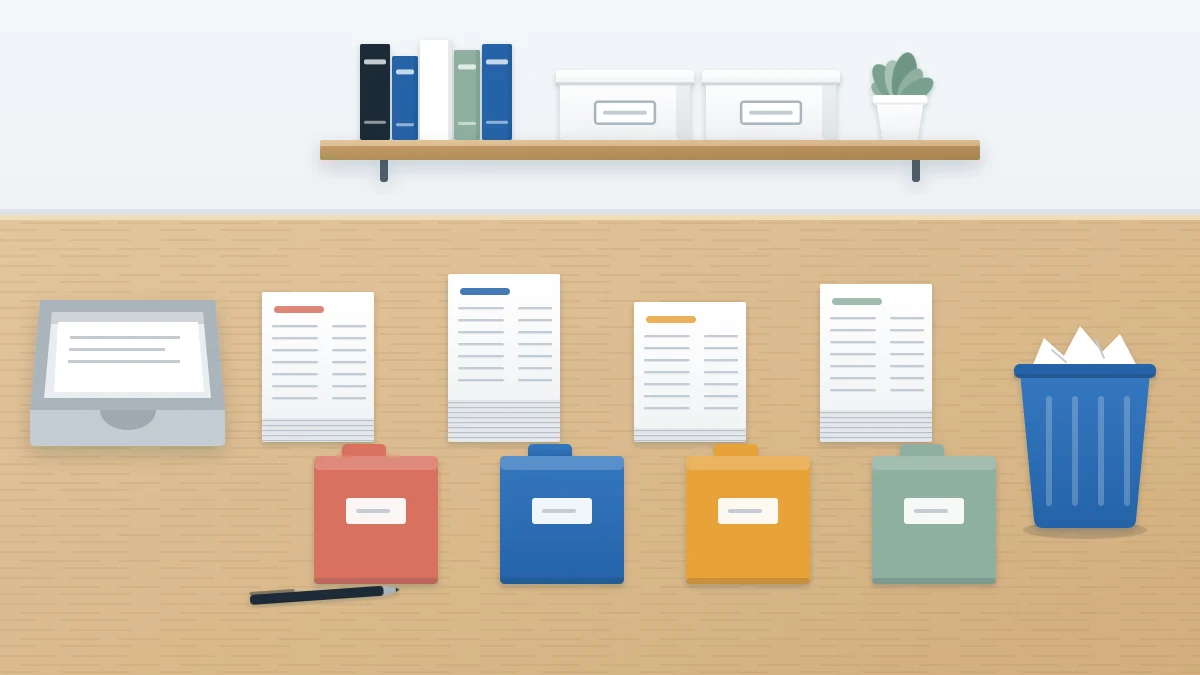
Sort any mixed pile of household and work paper into four piles (act on, file, recycle, shred), group what you keep into broad categories and give active papers one visible tray.
At a glance
What you need
- Cleared table
- Four pile markers
- Recycling bin
- Bag or box for shredding
- Plain folders and a pen
- One letter tray
Mixed piles of paper are hard to deal with because each sheet seems to need its own decision. The simplest answer to how to organize paperwork is to reduce those decisions to one question per sheet, asked once: what happens to this next?
There are only four possible answers, which is why this system uses four piles. It covers household and work paper together, needs nothing more than a cleared table, and takes roughly an hour for an ordinary few weeks’ worth of paper.
What to gather
- A cleared table or a clean stretch of floor
- Four sheets of paper or sticky notes for pile markers
- A recycling bin or bag
- A second bag or box for shredding
- A handful of plain folders and a pen
- One letter tray
Bring all the loose paper from the desk, the kitchen counter, bags and the hallway to the table before you begin. If what you have is several boxes going back months or years, that is a bigger job with its own pace; use the method for clearing a backlog of paper clutter first and return here for the regular system.
The four piles
Write one marker for each pile and lay them in a row with space between.
| Pile | What goes on it | Where it ends up |
|---|---|---|
| Act on | Anything that needs you to do something: reply, pay, sign, call, return | The action tray or action folders on the desk |
| File | Papers with nothing left to do that you need to keep | Your filing box, drawer or binders |
| Recycle | Paper you do not need that shows no personal details | The recycling bin |
| Shred | Paper you do not need that shows personal details | The shredder, then recycling |
Step by step: the sort
- Take one sheet from the top. Do not hunt for the easy ones. Working from the top down keeps the pace steady.
- Open and flatten it. Take letters out of envelopes, unfold them and remove inserts and outer envelopes, which go straight to recycling unless they carry your details.
- Ask the one question. Does it need action? Act on. No action but worth keeping? File. Not needed? Recycle, or shred if it shows a name with an address, an account number, a signature or similar details.
- Place it and move on. Do not read in full, pay or reply now. Sorting and doing are separate jobs, and mixing them is what makes a pile take all afternoon.
- Keep multi-page documents together. Use a paper clip or staple so pages do not scatter between piles.
- Clear the easy piles first. When the stack is gone, carry the recycling out and put the shred pile in its container. Two of the four piles have now left the table.
Tip
If you cannot decide between filing and discarding, do not start a fifth pile. Put the sheet on the file pile. How long a paper should be kept depends on what it is and where you live, so check official guidance or ask a qualified professional before you let go of anything you are unsure about.
Group the file pile into broad categories
Now spread the file pile out and group it by how you would look for each paper later. Use the word that comes to mind when you need the document, not a formal label.
Most households end up with between five and ten groups. Typical ones include:
- Home (lease or property papers, repairs, utilities)
- Vehicle
- Medical
- Insurance
- Bank and money
- Work or business
- School and children
- Manuals and warranties
- Personal records (certificates, identity documents)
Keep the groups broad at this stage. A folder marked “Medical” that holds everything medical is easy to file into and quick enough to search. Put each group in a plain folder and write its name on the front in pen.
These folders are the raw material for permanent storage. Choosing a container, adding subfolders and arranging the order are covered in the guide to setting up a home filing system.
Give active papers one visible place
The act-on pile must not go in a drawer, because paper you cannot see is paper you forget. It stays on the desk, in one of two forms.
One action tray
If you have only a few active papers at a time, a single letter tray is enough. Lay the papers in it with the nearest deadline on top.
A small set of action folders
If the tray would be more than a finger deep, split it into three or four folders standing upright in a desktop file, named for the kind of action:
- To pay
- To reply or call
- To sign and return
- Waiting (you have acted and are expecting an answer)
When a paper’s action is finished, it leaves the tray at once: to the file folders, the recycling or the shredder.
Where each pile physically goes
- Act on: the tray or action folders, on the desk, in view.
- File: the category folders, stored upright in a box, drawer or magazine file within a step or two of the desk.
- Recycle: a bin beside the desk, emptied weekly.
- Shred: a marked container next to the shredder, or a bag kept until you can shred in one batch. Shred before recycling, every time.
Label the shredding container clearly so nobody in the household empties it into the ordinary recycling by mistake.
How new paper enters the same path
A sort only lasts if tomorrow’s paper follows the same route. Three habits keep it flowing.
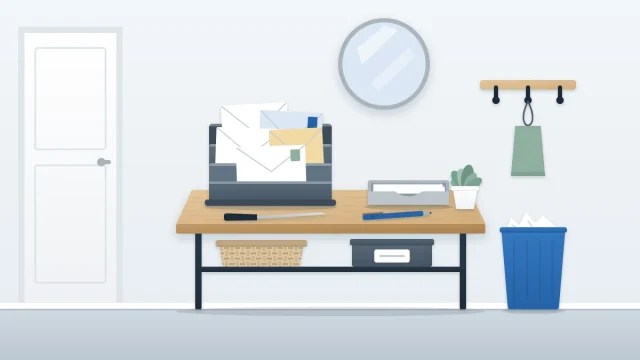
- One entry point. All incoming paper, whether mail, printouts or forms brought home, lands in a single inbox tray. Setting that up near the door is covered in the guide to making a mail station.
- The same four answers. When you empty the inbox, each sheet goes to act on, file, recycle or shred. No sheet goes back into the inbox.
- A fixed emptying day. Once a week is enough for most homes. A week of paper takes a few minutes; three months of paper takes an afternoon.
Adapting the system
Two people’s paper: sort together, but give each person their own action tray or folder color so nothing is acted on twice or left for the other.
No spare table: use four magazine files or shoeboxes as the piles and sort on your lap. The containers can be stacked and put away between short sessions.
Household and work paper mixed: run one sort, then split the file pile into a household set and a work set of folders so each can be stored where it is used.
Frequently asked questions
What is the fastest way to sort a pile of paperwork?
Take each sheet from the top, flatten it and ask one question: what happens to this next? Place it on one of four piles (act on, file, recycle or shred) and move on without reading in full, paying or replying. Do those tasks afterward, once the pile is gone.
Which papers should be shredded instead of recycled?
Shred any paper you are discarding that shows personal details, such as a name with an address, account or reference numbers, a signature or medical information. Keep a marked container for these beside the shredder, shred in batches and put the shredded paper out with recycling if your local service accepts it.
How many categories should I sort paperwork into?
Fewer than you expect. Most households manage with five to ten broad groups such as home, vehicle, medical, insurance and work. Name each one with the word you would think of when looking for the paper. Broad groups are quick to file into, and you can add subfolders later if one grows large.