A Weekend Home Office Organization Project: Step-by-Step Plan
A two-day order of work for the whole room: clear, sort, measure and list on day one; place furniture, fill storage, set up paper flow, tidy cords and label on day two.

At a glance
What you need
- Six to eight sorting boxes or bags
- Trash and recycling bags
- Tape measure, notepad and pen
- Sticky notes and a marker
- Cleaning cloths
- Soft reusable cable ties
- Labels or a label maker
Organizing an office a little at a time works, but some rooms need one concentrated push: two days, an order of work and a clear finish line. Without an order, a weekend goes on moving the same boxes from the desk to the floor and back.
This home office organization project splits the job in two. Saturday is for clearing, sorting and planning, and nothing new is bought or placed. Sunday is for putting the room together: furniture, storage, paper, cords and labels. Each half-day ends at a point where the room can be left as it is.
Before the weekend
- Collect six to eight empty boxes or bags for sorting, plus trash and recycling bags.
- Find a tape measure, notepad, pen, sticky notes, a marker and cleaning cloths.
- Get soft reusable cable ties, and labels or a label maker.
- Check when your local recycling center and donation drop-off are open.
- Do not buy storage containers yet. You will not know what you need until Saturday afternoon.
The weekend at a glance
| Half-day | Checklist | Ends when |
|---|---|---|
| Saturday morning | Clear the floor and desk; empty and sort drawers and shelves; gather all paper into one box | Everything in the room has been sorted into keep or go |
| Saturday afternoon | Take out everything that is leaving; decide zones; measure drawers and shelves; write the container list | You have a room sketch and a shopping list |
| Sunday morning | Place furniture; fit containers; fill drawers and shelves; set up paper flow | Every kept item has a home |
| Sunday afternoon | Tidy cords; label everything; set up the reset routine; deal with leftovers | The floor is clear and the sorting boxes are gone |
Saturday morning: clear and sort
The morning has one purpose: to reduce what is in the room. Work in this order.
- Mark the sorting boxes: other rooms, donate, recycle, shred, trash, electronics.
- Clear the floor of everything that is not furniture.
- Clear the desk and wipe it. It becomes your sorting table.
- Empty the drawers one at a time, then the shelves one at a time, sorting each item into keep or one of the boxes.
- Drop every loose paper into a single box as you go. Do not read it today.
- Group the things you are keeping in loose piles by kind: writing tools, paper supplies, files, books, tech, equipment.
The full method, including what to do with old equipment, is in the zone-by-zone plan for home office decluttering.
Saturday afternoon: plan, measure and list
Start by getting the outgoing boxes out of the room: trash and recycling outside, donations into the car, other-rooms items delivered. The space you gain makes planning easier.
Decide the zones
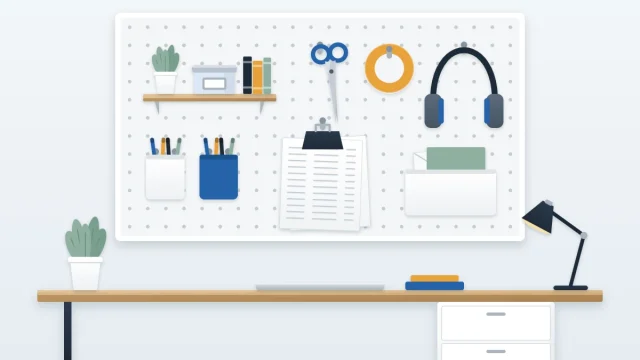
Sketch the room from above and mark where each kind of activity will happen: desk work, reference material, supply storage, and equipment such as the printer. The steps for sorting items into daily, weekly and rare use are in the guide to home office work zones. Write on the sketch which pile of kept items goes to which zone.
Measure
Measure the inside width, depth and height of every drawer and the clear width, depth and height of every shelf. Write the numbers on the sketch.
Write the container list
Look at each pile and ask what, if anything, it needs to sit in. Check first what you already own, because emptied boxes, trays and jars from the morning often cover half the list. Then write down only the gaps, with sizes: “two drawer trays, no wider than the top drawer”, “four magazine files”, “one lidded box for cables”.
Sunday morning: place and fill
- Place the furniture. Move the desk, shelving and drawer units to match the sketch before anything goes into them. Heavy pieces are far easier to shift empty.
- Fit the containers. Put dividers in drawers and boxes on shelves, empty, and check they fit as measured.
- Fill the drawers. Daily tools in the top drawer at the front, supplies below, bulky items or files in the deepest drawer.
- Fill the shelves. Weekly items between eye and hip level, light and rarely used boxes high, heavy items on the lowest shelf.
- Set up paper flow. Place one inbox tray where paper enters the room, a recycling bin and a shred container within reach of it, and a file box or drawer for papers you keep.
Leave Saturday’s box of loose paper closed. Give it a place on a low shelf and a date on the lid. Sorting a backlog is a separate job.
Sunday afternoon: cords, labels and routine
Tidy the cords
With the furniture in its final position, deal with the visible length of the cords. Switch off and unplug first. Remove any cord that serves nothing, group cords that run the same way with soft ties, loosely, and guide them along the back of the desk and down one leg, out of walkways.
Safety note
Do not overload an outlet or power strip, and follow the manufacturer’s instructions for the strip and for the devices plugged into it. Never plug one power strip into another. Keep cords out from under rugs and away from heat, and stop using and replace any cord or charger that is frayed, cracked or gets unusually hot. If the new layout calls for a new outlet, that is a job for a licensed electrician.
Label everything
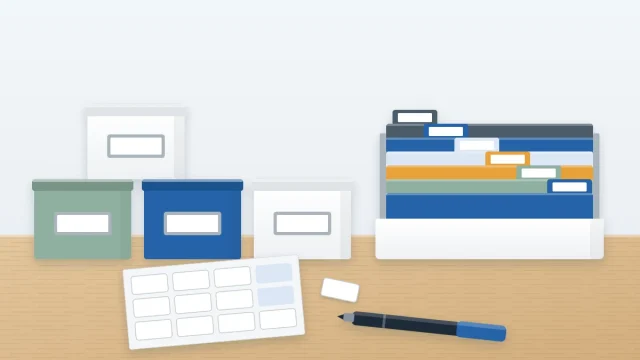
Label box fronts, drawer fronts, folder tabs and binder spines in one sitting, so the wording and position match across the room. The steps for building a set of home office labels cover the list, the wording and the placement.
Set up the reset routine
Decide today where the end-of-day items return to, and put a cleaning cloth within reach of the desk. The short daily and weekly steps are laid out in the routine to keep a home office organized.
What to do with the leftovers
By Sunday afternoon a few things will remain without a home.
- Kept items with no place: ask whether they belong in this room at all. If they do, one “to place” box is allowed, with a date on it and a spot on a shelf.
- Electronics: wipe personal data according to the maker’s instructions, then take them to a local recycling program.
- Empty sorting boxes: flatten and recycle them. The project is finished when they have left the floor.
Tip
If the weekend runs short, finish the half-day you are in and stop at its end point. Each one leaves the room usable, and the next can wait for a free evening.
Frequently asked questions
Should I buy storage containers before the weekend?
No. Wait until Saturday afternoon, after you have sorted the room, grouped what you are keeping and measured the drawers and shelves. By then you know exactly which containers are missing and what size they must be, and items you already own often fill part of the list.
What if I cannot finish the whole room in two days?
Each half-day is designed to end at a point where the room is usable. Finish the block you are working on, stop at its end point and pick up the next block on a free evening or the following weekend. Avoid starting a new block late in the day.
When in the weekend should I deal with the piles of paper?
Only gather it. Put all loose paper into one box on Saturday, set up an inbox tray and filing container on Sunday, and leave the box closed with a date on it. Sorting a paper backlog is a separate job that would otherwise use up most of the weekend.