Small Home Office Organization: Making a Tight Space Work
Seven principles for a corner, alcove or tiny room: set a limit, keep stock elsewhere, use the wall and the door, choose closed storage and keep the floor clear.
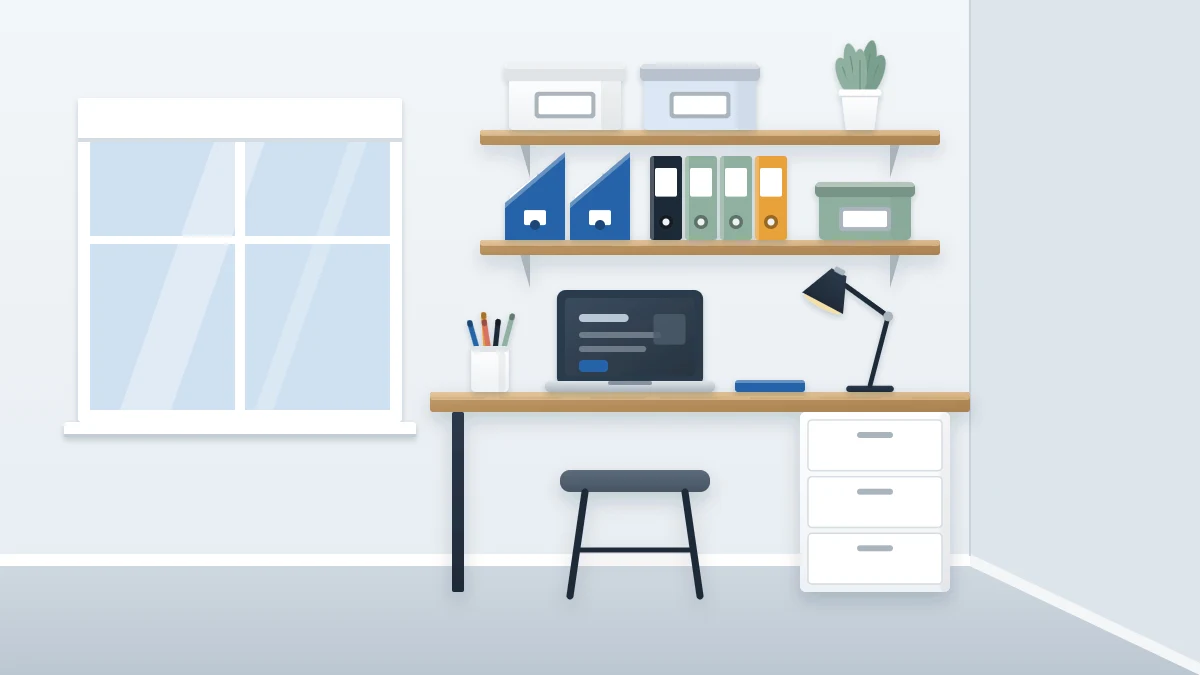
A desk in a corner, an alcove under the stairs or a box room barely wider than the chair: a small workspace has no spare surface to absorb a mess. One stack of paper or one extra box is enough to make the whole area feel full.
Small home office organization is less about clever products and more about limits. You decide what the space is allowed to hold, use the height above the desk, and move everything else to another part of the home. The seven principles below apply to almost any tight footprint.
Set a limit for what the space holds
Start with a short written list of what has to be within reach while you work. For most people that is a computer, a lamp, a few pens, one notebook, the papers in progress and a charger. Everything else is a candidate for moving out.
Then fix the containers and let them set the limit: one pen cup, one tray for active paper, one box of supplies, one shelf of reference material. When a container is full, something leaves before something new comes in.
Keep daily items at the desk and stock elsewhere
A small office does not need to store the household’s whole supply of printer paper, envelopes and spare notebooks. Keep a working amount at the desk, such as one pad, a few envelopes and a single spare ink cartridge, and store the rest in a hallway cupboard, a wardrobe shelf or a lidded box under a bed.
Sorting by how often you use each thing makes these calls easier. The guide to home office work zones shows how to split items into daily, weekly and rare, and that split works even when the far zones sit in a different room.
Tip
Tape a small card inside the supply box saying where the backup stock lives, for example “More paper: hall cupboard, top shelf”. Nobody has to hunt or buy a duplicate.
Use the wall above the desk
The wall between the desktop and the ceiling is usually the largest unused area in a small office. One or two shelves there can take the folders, boxes and books that would otherwise sit on the surface.
- Put the lowest shelf high enough to clear the monitor and the lamp, and low enough to reach while seated.
- Use the lower shelf for things you handle weekly and the higher one for light boxes you open now and then.
- Stand folders upright in magazine files so they take up a narrow strip of shelf instead of a flat pile.
- Leave the wall directly at eye level fairly plain. A solid wall of objects close to your face makes a small space feel crowded.
For the order in which to fill them, see how to arrange home office shelves by reach and use.
Safety note
Follow the manufacturer’s instructions and stated limits for any wall shelf, board or hook, and use fixings suited to the type of wall. If you rent, check your lease or ask your landlord before drilling, or choose a freestanding option such as a narrow bookcase or a shelf unit that stands on the desk. Keep heavy items on low shelves or on the floor-level unit, not above your head.
Choose closed storage for a corner that is always on view
When the office is part of a living room or bedroom, everything on it is in sight all evening. Open shelves full of mixed objects look busy even when they are in order.
Closed storage calms the view: boxes with lids, a cabinet with a door, a drawer unit, baskets in one color. Matching containers read as one block. Label the fronts so you do not have to open three boxes to find the stapler.
Keep open storage for the few things you use many times a day. A pen cup and one tray on show are fine. Twelve small objects on show are not.
Pick furniture that does two jobs
In a tight footprint every piece should earn its floor space twice.
| Piece | First job | Second job |
|---|---|---|
| Slim drawer unit under the desk | Holds supplies and paper | Its top is a stand for the printer or a bag |
| Rolling cart | Stores supplies beside the desk | Rolls into a closet or next to the sofa when work ends |
| Monitor riser | Raises the screen | Shelters the keyboard and a notebook underneath |
| Storage stool or ottoman | Extra seat | Holds files or bulky equipment inside |
Measure the gap under and beside the desk before choosing anything, including the room your knees and the chair need. If the desk itself has no storage at all, the ideas for a desk without drawers cover the options beside, above and beneath it.
Keep the floor clear
In a small room the floor is the first place overflow lands and the last place it leaves. Boxes on the floor block the chair, collect dust and make the room harder to clean.
- Nothing is stored on the floor except furniture and one wastebasket or recycling bin.
- Bags hang on a hook at the side of the desk or on the back of the chair.
- Cords are gathered along the back edge of the desk so they stay clear of your feet and the chair wheels.
- Deliveries and items waiting to be returned get one named spot outside the office, such as a shelf by the front door.
Use the back of a door
A door is a tall, flat surface that takes up no floor space. An over-door pocket organizer that hangs from the top edge needs no fixings and holds light things well: envelopes, labels, spare notebooks, cables in zip bags, scissors and tape.
Put what you use most in the pockets between shoulder and hip height. Check that the door still closes and that nothing knocks against the wall behind it.
When the space is smaller still
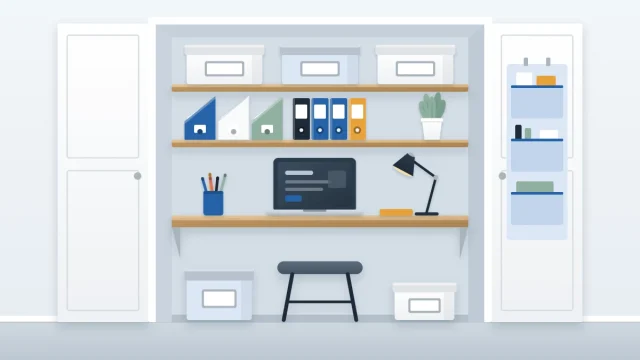
Some workspaces have no floor area of their own. If the only free spot is a reach-in closet, the same principles shrink to fit. See the steps for closet office organization, where the doors hide the lot at the end of the day.
Whatever the size, review the limit list every few months. Small spaces fill by single items, and it is easier to remove one thing a week than to clear the corner again from scratch.
Frequently asked questions
What should I move out of a small home office first?
Backup stock. Spare reams of paper, extra notebooks, boxes of envelopes and old equipment take up the most room and are touched least. Keep a working amount at the desk and store the rest in a cupboard elsewhere in the home, with a note at the desk saying where it is.
Is open or closed storage better in a small office?
Closed storage usually suits a small or shared room better, because lidded boxes, doors and drawers hide many small objects behind one plain surface. Keep open storage for the few items you reach for many times a day, and label the fronts of closed containers.
How can I add storage to a small office in a rented home?
Use options that need no fixings: a narrow freestanding bookcase, a shelf unit that stands on the desk, a rolling cart, a drawer unit under the desk and a pocket organizer that hangs over the top of a door. Check your lease or ask your landlord before putting anything on the wall.